From collection to system
An image collection becomes an archive when its arrangement and records allow someone other than the original collector to find, understand and evaluate it. This distinction matters most after time passes. The person who remembers every folder eventually changes computer, changes job or forgets why a file was renamed.
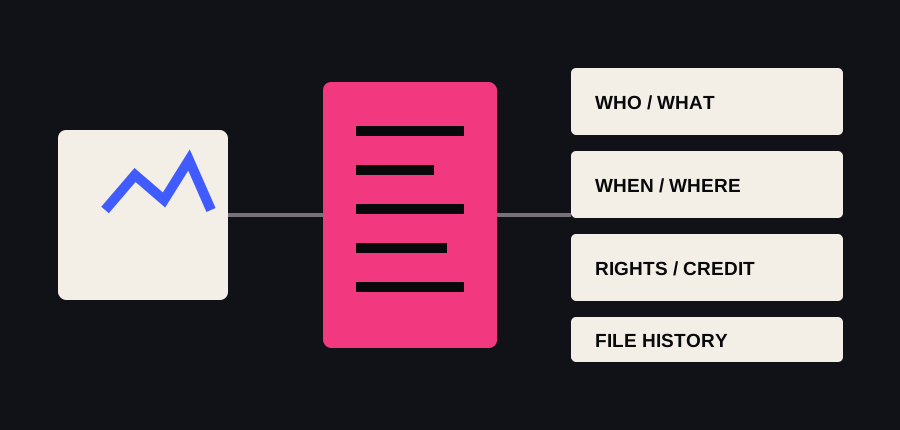
A reliable system links four things: the visual file, a stable identity, descriptive context and a preservation history. The file carries pixels. The identifier lets records continue when folders move. Description explains people, place and event. Preservation history records source, versions, checks and migrations.
Give every object a stable identity
Camera filenames repeat. Screenshots and exported edits often lose original names. A local identifier should therefore be unique within the archive and should not depend entirely on a folder path. It may combine a collection code, date and sequence, but it should remain stable even when a mistaken date is corrected.
Keep the source filename as metadata rather than using it as the sole identity. If two identical files arrive from different sources, a checksum can reveal the duplicate while separate acquisition records preserve their provenance. Identical pixels do not always mean identical documentary history.
Metadata is evidence with confidence levels
Descriptive fields should separate direct knowledge from inference. Camera metadata may provide a timestamp, but the clock could have been wrong or set to another time zone. A contemporary programme may establish an event date more strongly. A later social post may identify a costume without proving exactly when the photograph was made.
Record the source of important claims. If a person is identified by the photographer, say so. If a location is inferred from visible signage, mark it as an inference. Controlled vocabulary helps search, but uncertainty must not be forced into a confident category merely to keep the database tidy.
Keep originals and derivatives distinct
The archival original is the best available source file, not necessarily the oldest file found. A raw camera file may contain more information than a published JPEG; a high-resolution scan may be the practical preservation master for a fragile print. Document the relationship rather than declaring one universal format superior.
Edits belong in derived files. Crops, colour treatments, sharpening and web compression serve real purposes, but overwriting the source removes the ability to evaluate those decisions later. Version labels should be functional: master, access copy, web crop, print edit. Terms such as “final-final-2” describe frustration, not provenance.
File formats and storage media change. Multiple copies in separate locations reduce the chance that one failed drive or account removes the collection. Periodic checksum verification can detect silent corruption. A backup that has never been restored is still an assumption.
Rights information is part of access
Possessing a copy does not automatically grant publication rights. An archive should record the photographer when known, the source of the file, any licence or agreement, restrictions on subjects or locations, and the date of a rights decision. “Found online” is a source note, not permission.
Rights can be layered. A photographer may own the photograph while a depicted artwork, costume design or performance has separate interests. Privacy, publicity and venue rules vary by jurisdiction and context. An archive record should identify questions for review rather than offer a false universal clearance.
Design for understandable survival
The strongest preservation plan is legible. Document folder structure, identifier rules, required fields, backup locations and who can make changes. Export metadata in open, readable formats alongside any specialist database. A future custodian should be able to reconstruct the relationship between files and records without access to one abandoned application.
Finally, record deletion and restriction decisions. Removing duplicates, unsafe material or files without permission can be responsible stewardship, but the policy should explain what was removed and why. An archive is shaped by absence as well as presence.